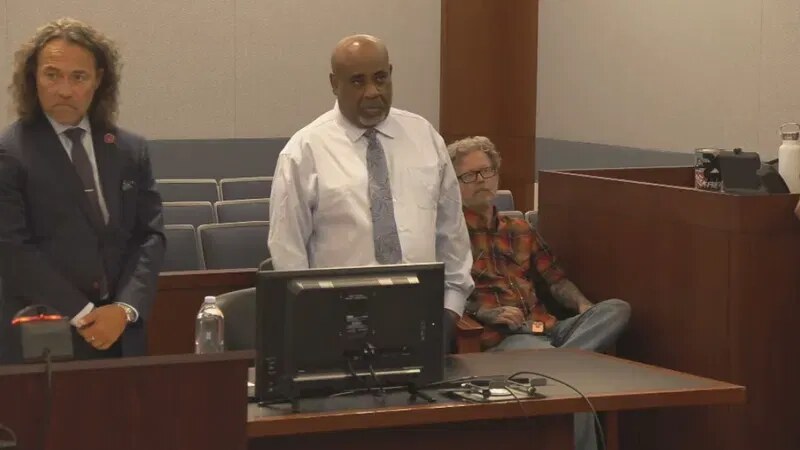
For three days, the Tupac Shakur murder trial has technically been underway without anyone arguing about who killed Tupac.
There have been no opening statements. No witnesses. No autopsy evidence. No testimony about the white Cadillac that pulled alongside Tupac and Suge Knight on September 7, 1996.
Instead, the battle has been over who will ultimately decide the case.
On Wednesday, August 12, Day Three of State of Nevada vs. Duane “Keffe D” Davis brought the court significantly closer to answering that question as jury selection continued inside the Regional Justice Center in Las Vegas.
By the end of the day’s proceedings, 36 prospective jurors had advanced to the next round, reaching the number Judge Carli Kierny wanted before beginning the final stages of jury selection.
Thursday could now be the day the actual jury is seated.
And Day Three offered several interesting moments along the way.
Day Three at a Glance
- Date
- Wednesday, August 12, 2026
- Court
- Regional Justice Center, Las Vegas
- Judge
- Carli Kierny
- Stage
- Continued questioning of prospective jurors
- Pool Size
- 36 prospective jurors advanced
- Next Step
- Peremptory challenges — 10 per side
- Final Jury
- 12 jurors plus four alternates
- Opening Statements
- Currently anticipated Monday
A Potential Juror With a Diddy Connection
One of Wednesday’s more unusual moments involved a prospective juror who told the court she had been around Sean “Diddy” Combs.
According to courtroom reporting from News 3, the woman identified herself as a social worker who now works as a bartender on the Las Vegas Strip.
She told the court she had watched documentaries involving Combs, Tupac Shakur and Christopher “The Notorious B.I.G.” Wallace and recalled feeling uncomfortable during her previous encounter with Combs.
Despite that history and familiarity with the broader story surrounding Tupac, she was asked to return Thursday for the next stage of jury selection.
The moment was particularly noteworthy because Combs’ name has hovered around discussions of the case for decades.
But the defense made something clear in court Wednesday:
Sean Combs will not be coming to court.
That distinction matters.
The fact that someone’s name has appeared in decades of reporting, interviews and speculation surrounding Tupac’s murder does not mean that person will testify or is accused of involvement in the case currently being tried.
This trial is about whether prosecutors can prove their case against Duane Davis.
Another Juror’s Background Raises Questions
Day Three also produced a potentially significant issue involving one of the prospective jurors who had already advanced.
Prosecutors asked that the record reflect concerns that the individual may have provided incorrect information about his criminal history.
Judge Kierny indicated that she reviewed the man’s record in justice court and plans to question him further Thursday.
The court did not publicly explain how the possible discrepancy was discovered.
The issue demonstrates exactly how carefully both sides are scrutinizing the people who could ultimately determine Davis’ fate.
In a case where credibility is expected to become a major theme, even the credibility of the prospective jurors themselves matters.
Some Moved Forward. Others Went Home.
Wednesday’s questioning continued revealing just how different the backgrounds of the potential jurors are.
One man said he knew very little about Tupac Shakur and was advanced to Thursday’s proceedings.
Another prospective juror said he had been the victim of a robbery that he never reported and acknowledged that the experience created a bias for him. He was dismissed.
A woman who described having an abusive uncle and being afraid of crime scenes was also excused.
Another woman expressed uncertainty about how she would respond to graphic photographs from a homicide case and was dismissed.
Others advanced, including a woman who said she had family members in law enforcement.
Each answer matters because whoever ultimately sits in those 12 jury seats will be asked to evaluate a case involving gang allegations, graphic evidence, decades-old memories and a defendant whose own public statements could become some of the prosecution’s most important evidence.
The Defense Does Not Have to Prove Davis Is Innocent
One fundamental principle of criminal law was also emphasized during Wednesday’s proceedings.
The defense does not carry the burden of proving that Davis is innocent.
The burden belongs to the State of Nevada.
Davis has pleaded not guilty, and prosecutors must prove the criminal charge against him beyond a reasonable doubt.
That distinction will become increasingly important once opening statements begin.
For nearly 30 years, the public conversation surrounding Tupac’s murder has often treated rumors, theories and alleged street knowledge as established fact.
A courtroom operates differently.
Prosecutors will have to establish their case through admissible evidence and testimony.
Davis’ attorneys only need to create reasonable doubt.
Now There Are 36
By Wednesday evening, the court had reached an important milestone.
Thirty-six prospective jurors have advanced.
On Thursday, prosecutors and defense attorneys are expected to begin exercising their peremptory challenges.
Each side will have 10 peremptory strikes, allowing attorneys to remove certain prospective jurors without having to establish the same type of cause required for other dismissals, subject to constitutional restrictions against discriminatory jury selection.
The objective is to ultimately seat:
12 jurors and four alternates.
If everything proceeds according to schedule, the final jury could be seated by the end of Thursday.
That would fundamentally change the nature of the proceedings.
Then the Real Trial Begins
For three days, the Tupac murder trial has been about selecting the people who will hear the case.
Soon, it becomes about the evidence.
Prosecutors allege Davis helped orchestrate the September 1996 shooting following the MGM Grand confrontation involving Tupac, members of the Death Row Records entourage and Davis’ nephew Orlando “Baby Lane” Anderson.
Davis is not accused of personally firing the fatal shots.
Instead, prosecutors allege that he participated in the retaliatory plan and provided the weapon used in the attack.
Davis has pleaded not guilty.
Once opening statements begin, prosecutors will finally have to explain to jurors how they intend to prove those allegations nearly three decades after the crime.
The defense will begin explaining why those same jurors should not believe them.
And looming over everything will be Davis’ own words.
His interviews.
His public statements.
His memoir.
And the defense’s contention that some of those stories were exaggerated or fabricated.
Day Three: The Courtroom Is Almost Ready
Day Three may not produce the kind of headline that comes from explosive witness testimony.
But it could prove enormously consequential.
The pool is now at 36.
Thursday is expected to narrow that group to the 16 people who will sit through one of the most anticipated murder trials in music history.
Twelve will ultimately deliberate.
Four will serve as alternates.
And if the current schedule holds, opening statements are expected Monday.
Thirty years of theories are about to collide with something very different: Evidence.
For generations of hip-hop fans who have wondered what really happened on that September night in Las Vegas, the preliminary process is almost over.
The jury that could ultimately decide whether Duane “Keffe D” Davis is legally responsible for the murder of Tupac Shakur is about to take its seats.
Black Beat Trial Watch
Black Beat Magazine will continue following State of Nevada vs. Duane “Keffe D” Davis as the Tupac Shakur murder trial unfolds in Las Vegas, separating courtroom evidence and testimony from the rumors and mythology that have surrounded the case for nearly 30 years. Catch up with Day One and Day Two. Also read our open letter on Tupac, accountability, justice and legacy.