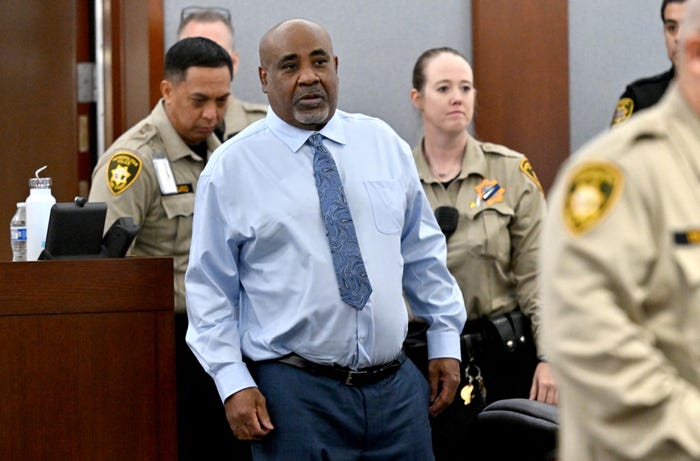
Nearly three decades after Tupac Shakur was fatally wounded on the streets of Las Vegas, one of the most closely watched murder cases in music history has finally reached a courtroom.
On Monday, August 10, 2026, jury selection began in the State of Nevada’s murder case against Duane “Keffe D” Davis, the 63-year-old former South Side Compton Crips figure accused by prosecutors of helping orchestrate the September 1996 shooting that ultimately claimed Tupac’s life.
Day One did not bring opening statements, dramatic witness testimony or the presentation of evidence. Instead, the focus inside Clark County District Court was on perhaps the most important first step in any criminal trial: finding jurors capable of deciding one of America’s most famous unsolved murder cases based on evidence presented in court rather than three decades of headlines, documentaries, books, music and speculation.
District Court Judge Carli Kierny began the proceedings by reviewing the jury-selection process with prosecutors and Davis’ defense team. Approximately 75 prospective jurors were brought into the process, with the court examining possible conflicts, medical issues, language barriers and other circumstances that could prevent them from serving during a trial expected to last roughly four to five weeks.
The questioning also demonstrated the unusual challenge facing both sides. This is not an obscure criminal prosecution. Tupac Shakur remains one of the most recognizable figures in music history.
Prospective jurors were asked about subjects ranging from their favorite books and movies to whether they had connections to gangs and whether they had listened to Tupac’s music. Prosecutors also read names associated with the case to determine whether jurors were familiar with them, including former Death Row Records CEO Marion “Suge” Knight and Sean “Diddy” Combs.
By early afternoon, attorneys had begun individually questioning prospective jurors. According to local courtroom reporting, questioning of the first prospective juror lasted nearly an hour, illustrating how carefully the court is approaching the selection process.
Davis appeared calm during Monday’s proceedings, sitting beside defense attorney Michael Sanft and occasionally speaking quietly with him as prospective jurors answered questions.
One significant legal decision also came directly from Davis.
Davis waived his right to have a jury determine his sentence should he ultimately be convicted. That means Judge Kierny, rather than the jury, would determine the penalty following any guilty verdict.
The Case at a Glance
- Case
- State of Nevada v. Duane “Keffe D” Davis
- Court
- Clark County District Court, Las Vegas
- Judge
- Carli Kierny
- Defense
- Michael Sanft
- Charge
- Murder with a deadly weapon with the intent to promote, further or assist a criminal gang
- Plea
- Not guilty
- Day One
- August 10, 2026 — jury selection, roughly 75 prospective jurors
- Expected Length
- Four to five weeks
- Witnesses
- Prosecutors reportedly preparing to call approximately 35 to 45
What the State Must Prove
Davis has pleaded not guilty to murder with a deadly weapon with the intent to promote, further or assist a criminal gang.
Importantly, Nevada prosecutors are not alleging that Davis personally fired the bullets that struck Tupac.
Their theory is that Davis participated in and helped direct the chain of events that resulted in the shooting, including allegedly obtaining and providing the firearm used during the attack.
The prosecution contends that the shooting was retaliation following the now-infamous September 7, 1996 altercation inside the MGM Grand involving Tupac, members of the Death Row entourage and Orlando “Baby Lane” Anderson, Davis’ nephew.
Hours later, Tupac was riding in the passenger seat of a BMW driven by Suge Knight when a white Cadillac pulled alongside them near the Las Vegas Strip. Gunfire erupted.
Tupac was struck multiple times. He died six days later on September 13, 1996. He was 25 years old.
For years, Anderson was widely considered a suspect in the shooting, although he was never charged. He was killed in an unrelated Compton shooting in 1998.
The other men authorities have identified as having been inside the Cadillac are also dead, leaving Davis as the only surviving alleged occupant of the vehicle.
Davis’ Own Words Will Be at the Center of the Case
One of the most consequential battles in this trial may not involve physical evidence from 1996 at all.
It may involve Davis’ own words.
Over the years, Davis publicly discussed the events surrounding Tupac’s murder through interviews, television appearances and his memoir, Compton Street Legend. Prosecutors contend those statements provide critical evidence connecting him to the murder.
The defense has taken a dramatically different position, arguing that Davis exaggerated or fabricated portions of those stories for notoriety and financial gain.
That conflict creates what could become the central question of the trial:
Judge Kierny previously ruled that significant evidence prosecutors intend to use, including Davis’ memoir and a 2008 police interview, can be admitted at trial.
Who Actually Fired the Gun?
Another major question hangs over the proceedings.
Who fired the shots?
The prosecution does not necessarily have to establish that Davis was the shooter to pursue its murder theory against him. But testimony expected during the trial could challenge one of the most repeated narratives surrounding Tupac’s death.
Orlando Anderson has long been publicly identified as the suspected gunman.
However, Denvonta Lee, a former South Side Compton Crips affiliate expected to be among the prosecution’s witnesses, previously gave grand jury testimony presenting a different account. According to reporting on that testimony, Lee claimed Anderson did not have a clear shot and that Deandrae “Freaky” Smith ultimately fired the weapon.
Smith is now deceased.
That means the trial could potentially leave one of the public’s biggest questions unresolved even if jurors reach a verdict against Davis.
Suge Knight Remains a Wildcard
One of the most intriguing potential witnesses is the man who was sitting beside Tupac when the bullets entered their BMW.
Suge Knight survived the shooting and is one of the few remaining people with firsthand knowledge of what occurred at the intersection that night.
Knight is currently serving a 28-year prison sentence in California and has publicly indicated that he does not want to testify.
Davis’ attorney has suggested Knight could actually be beneficial to the defense if he takes the witness stand.
Whether Knight ultimately appears could become one of the trial’s most closely watched developments.
Prosecutors are reportedly preparing to call approximately 35 to 45 witnesses during the case, although inclusion on a witness list does not guarantee someone will testify.
Three Decades of Questions Enter a Courtroom
Perhaps the most striking element of Day One was simply that it happened.
For almost 30 years, Tupac Shakur’s murder existed somewhere between an active homicide investigation and hip-hop mythology.
There have been documentaries. Books. Interviews. Conspiracy theories. Conflicting witness accounts. Street stories. Police investigations.
And endless debates over who ordered the killing, who was inside the Cadillac and who pulled the trigger.
Now, for the first time, a jury will be asked to separate that mythology from evidence admissible in a court of law.
Tupac would have turned 55 years old this year.
Instead, his life remains frozen in the public imagination at 25, making the sight of a defendant finally sitting inside a Las Vegas courtroom nearly three decades later particularly significant for generations of fans who grew up with his music.
Day One of State of Nevada v. Duane Davis did not answer the question the world has been asking since September 1996.
It was never expected to.
But it marked something that once seemed increasingly unlikely: the murder of Tupac Shakur is finally before a jury.
And after nearly 30 years of rumors, interviews and speculation, the next several weeks may determine what can actually be proven in a court of law.
Black Beat Trial Watch
Black Beat Magazine will continue following State of Nevada v. Duane “Keffe D” Davis as the Tupac Shakur murder trial unfolds in Las Vegas. Continue with Day Two. Also read our open letter on Tupac, accountability, justice and legacy.