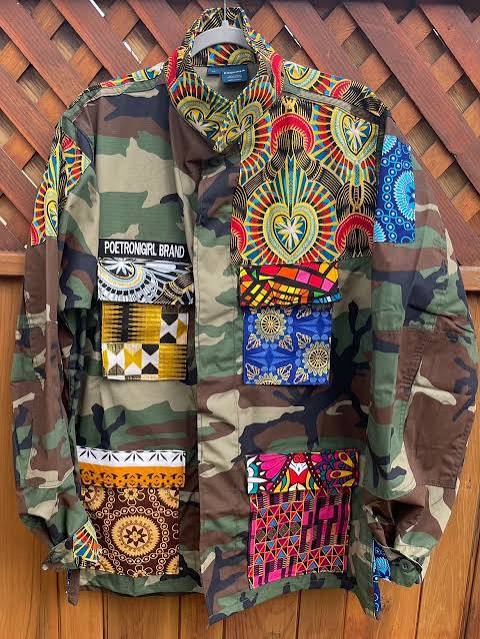
Long before social media turned everyone into a storyteller, PoetRoniGirl understood the power of telling our own stories.
For Veronica “Roni” Walter, better known as PoetRoniGirl, creativity has never belonged to a single medium.
Sometimes it arrives through a microphone.
Sometimes through poetry.
Sometimes through an old photograph.
Sometimes through a discarded piece of fabric that someone else might overlook.
And sometimes, it arrives on the back of an army jacket.
Across a creative career spanning more than three decades, PoetRoniGirl has built a body of work at the intersection of poetry, fashion, hip-hop, Black history and Los Angeles culture. She has been a poet, producer, designer, entrepreneur, mentor and cultural storyteller.
What connects those identities is something larger than art.
It is preservation.
Her work poses an increasingly important question: Who is responsible for making sure our stories survive?
PoetRoniGirl appears to have answered that question a long time ago.
Before the Jackets, There Were the Words
To understand PoetRoniGirl the designer, you first have to understand PoetRoniGirl the poet.
Her roots reach deep into Los Angeles’ spoken-word community.
During the 1990s, when poetry venues served as creative laboratories for an emerging generation of writers and performers, Roni was already helping create spaces where voices could develop.
Poet Shihan Van Clief has identified Walter as his poetry mentor and recalled that his first open mic experience was at The Juke Joint on Melrose, hosted by Roni. That scene would help connect artists who became part of Los Angeles’ influential spoken-word community.
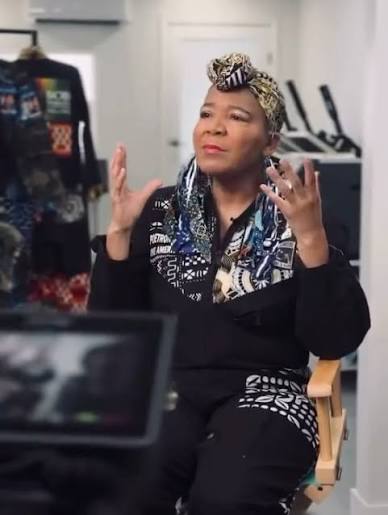
Her presence extended to some of the city’s most recognizable entertainment venues.
Roni produced poetry and concert programming at The Comedy Store on Sunset Boulevard, where she became the first poet to host a show at the legendary comedy venue. She later produced and hosted Roni’s Backstreet Poetry with actress Pam Grier at the former House of Blues Sunset Strip.
Her poetry even entered television history when her words were performed by Brandy on the hit television series Moesha.
Years later, her connection to poetry remains active. In February 2026, California State University, Northridge featured PoetRoniGirl during its second annual Black Poetry Works: Celebration of Black Poets and Poetry, organized through the university’s Communication Studies and Africana Studies programs.
The microphone never really disappeared.
It simply became one of several canvases.
Poetry You Can Wear
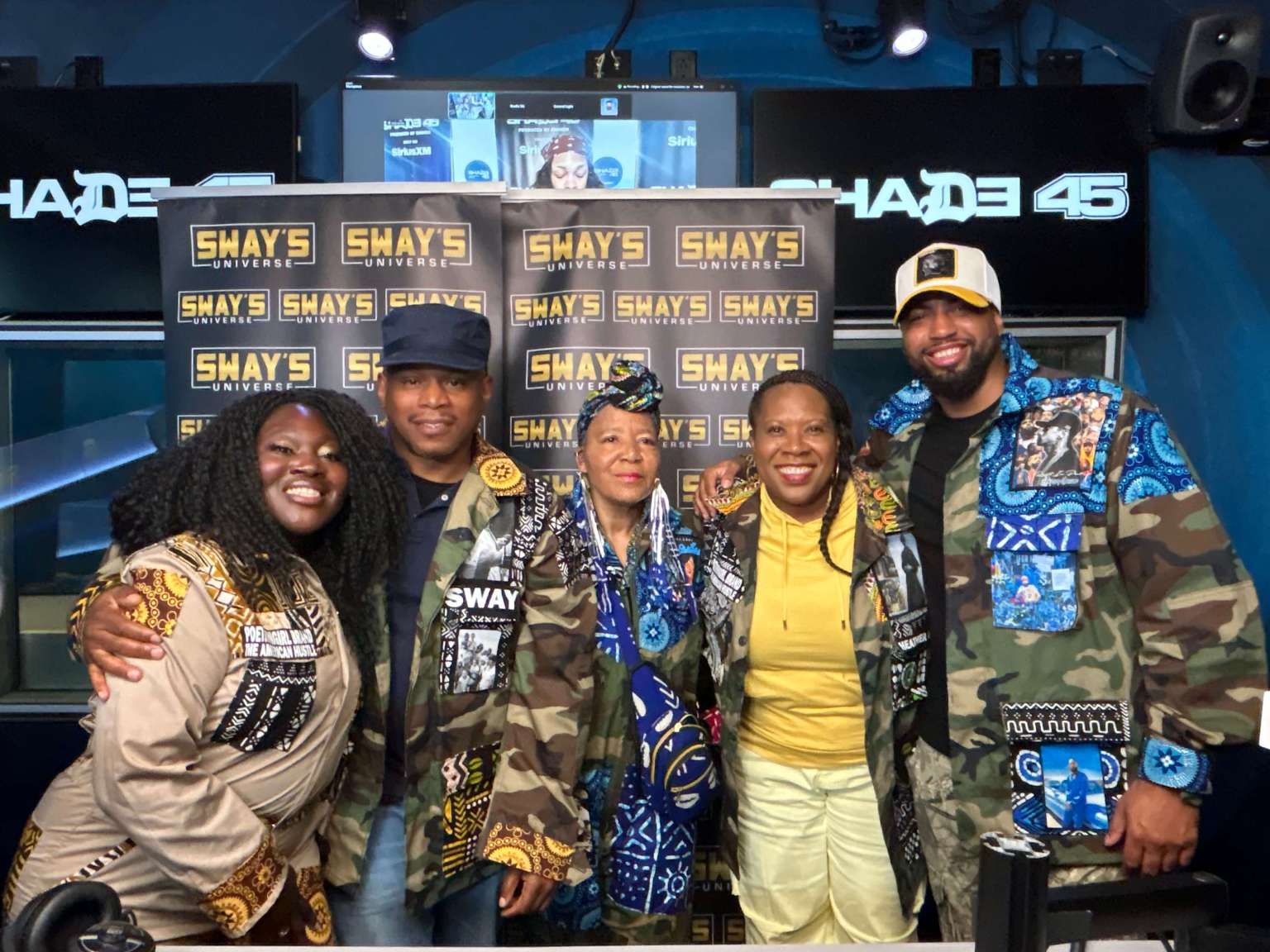
Look closely at one of PoetRoniGirl’s jackets and the connection becomes obvious.
These aren’t simply garments decorated with images.
They are compositions.
A photograph occupies space the way a verse might occupy a stanza. Fabric becomes texture. Color establishes mood. Placement creates rhythm.
Her Army Couture work draws particular inspiration from her parents, both military veterans. Vintage photographs, African fabrics, reclaimed textiles, personal keepsakes and cultural imagery can all become components of a finished piece.
That makes each garment inherently personal.
A jacket can become a family archive.
A memorial.
A celebration.
A history lesson.
Or all four simultaneously.
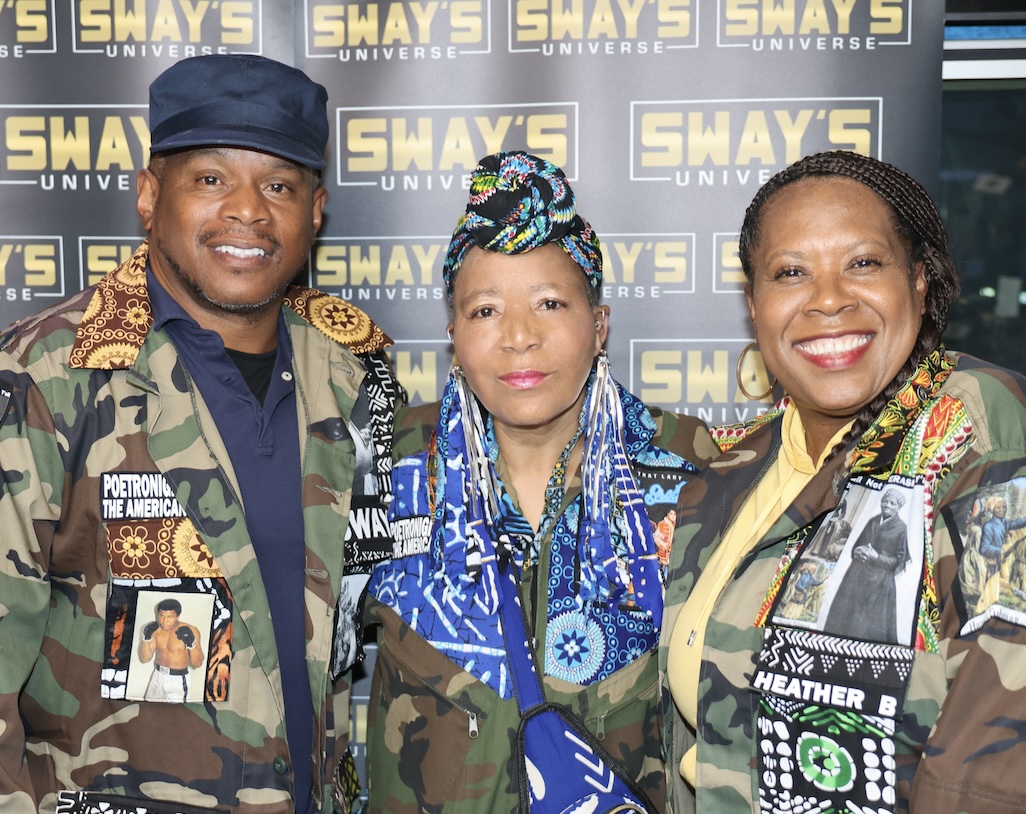
Her Legacy Line has celebrated cultural figures including Marvin Gaye, Muhammad Ali, Bob Marley, Harriet Tubman and Nipsey Hussle.
The philosophy behind the work may be best summarized by the declaration associated with her brand:
“We will not be erased.”
Those five words transform fashion into something considerably more consequential.
They make it an act of cultural preservation.
Black History Doesn’t Have to Live in a Museum
There is something powerful about carrying history on your back.
Black history is often presented as something to be studied retrospectively. It exists inside books, documentaries, museums, archives and Black History Month programming.
PoetRoniGirl challenges that limitation.
History can walk down Crenshaw.
History can enter a recording studio.
History can attend a concert.
History can walk a red carpet.
History can be worn.
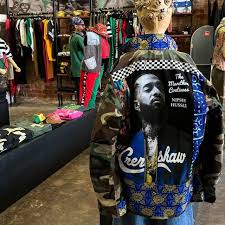
Her designs have been worn by an eclectic group of recognizable cultural figures, including Tabitha Brown, Sheryl Lee Ralph, Doodlebug of Digable Planets, Dominique DiPrima, Sway Calloway and Heather B.
Her earlier fashion venture, Happi Nappi Wear, also found its way into celebrity culture, with pieces reportedly worn by Will Smith and Bobby Brown.
That history matters because it demonstrates that PoetRoniGirl’s transition into wearable art was not some sudden response to today’s customization economy.
Fashion has been part of her creative vocabulary for decades.
Before Upcycling Became Fashionable
There is another dimension to Roni’s work that feels particularly contemporary: sustainability.
Except she was doing it before sustainability became one of fashion’s favorite marketing terms.
Her process incorporates deadstock, discarded textiles, fabric remnants and existing garments, transforming material that might otherwise be wasted into new pieces.
In 2019, California Apparel News featured Roni among designers working with sustainable materials. She described her mission as saving the planet “one garment at a time” and discussed searching for discarded fabrics and scraps that could be incorporated into her designs.
Her approach represents something Black communities have practiced for generations.
Reuse.
Reimagine.
Reconstruct.
Make something valuable from what somebody else discarded.
There is an unmistakable parallel between that process and the African American quilting tradition. Fragments become narratives. Individual pieces become a larger composition. Memory becomes material.
PoetRoniGirl does it with jackets.
The People’s Designer
Fashion has always had gatekeepers.
Luxury fashion, especially, often depends upon exclusivity. The designer occupies one world and the customer another.
PoetRoniGirl’s work feels different.
Her pieces begin with people.
Their photographs.
Their parents.
Their memories.
Their heroes.
Their history.
That relationship helps explain why she has been described as “The People’s Designer.”
The title fits because the most interesting element of her work isn’t necessarily the celebrity wearing one of her jackets.
It is the possibility that someone’s grandmother could occupy the same visual importance as Marvin Gaye.
A father’s military photograph can become art.
A family picture buried inside an album can become the centerpiece of a garment.
A personal memory can become something worthy of preservation.
That is a profoundly Black artistic tradition.
Our history has never been limited to famous people.
Our history lives in family photo albums, church programs, record collections, military photographs, school yearbooks, neighborhood businesses and stories passed between generations.
PoetRoniGirl takes those fragments and gives them another life.
A Creative Bridge Between Generations
Perhaps the most compelling part of PoetRoniGirl’s story is longevity.
Creative culture has changed dramatically during her career.
She experienced an era when open mics built communities without algorithms.
She worked in fashion before Instagram boutiques existed.
She created sustainable garments before “upcycling” became a mainstream fashion category.
She helped cultivate poetry spaces before spoken word could go viral on TikTok.
And she continues creating.
That makes her more than someone who participated in a particular era.
She is a bridge between eras.
Her career connects the intimacy of 1990s Los Angeles poetry culture with contemporary wearable art. It connects the oral tradition of Black storytelling with visual design. It connects hip-hop’s instinct for reinvention with an older Black tradition of turning limited materials into extraordinary expressions.
Even in 2026, her work continues to intersect with contemporary hip-hop culture. PoetRoniGirl Brand was among the participants announced for the GRAMMY Museum’s 2026 Hip-Hop Block Party in Los Angeles.
The culture continues moving.
So does she.
More Than Fashion
There is an easy way to describe PoetRoniGirl.
Poet.
Designer.
Entrepreneur.
Any of those descriptions would technically work.
None feels complete.
Because when you examine the totality of her career, another description emerges.
Not the kind wearing white gloves inside a climate-controlled room.
The kind carrying scissors, photographs, textiles, poetry and decades of memories.
The kind who understands that preserving Black culture does not always require an institution.
Sometimes it requires imagination.
Sometimes it requires a microphone.
Sometimes it requires remembering the people who came before us.
And sometimes it requires taking an old army jacket and turning it into something that refuses to allow history to disappear.
That may ultimately be the thread running through everything PoetRoniGirl has created.
Her poetry gives memory a voice.
Her fashion gives memory a body.
Her art gives memory somewhere to live.
After more than three decades of creating, mentoring, designing and documenting culture in her own unmistakable way, PoetRoniGirl continues doing what Black artists have always done best: transforming lived experience into something the next generation can inherit.
Because trends eventually disappear.